Walk More, Squat More and Move in Nature More
The body was made to move, not merely to exercise.
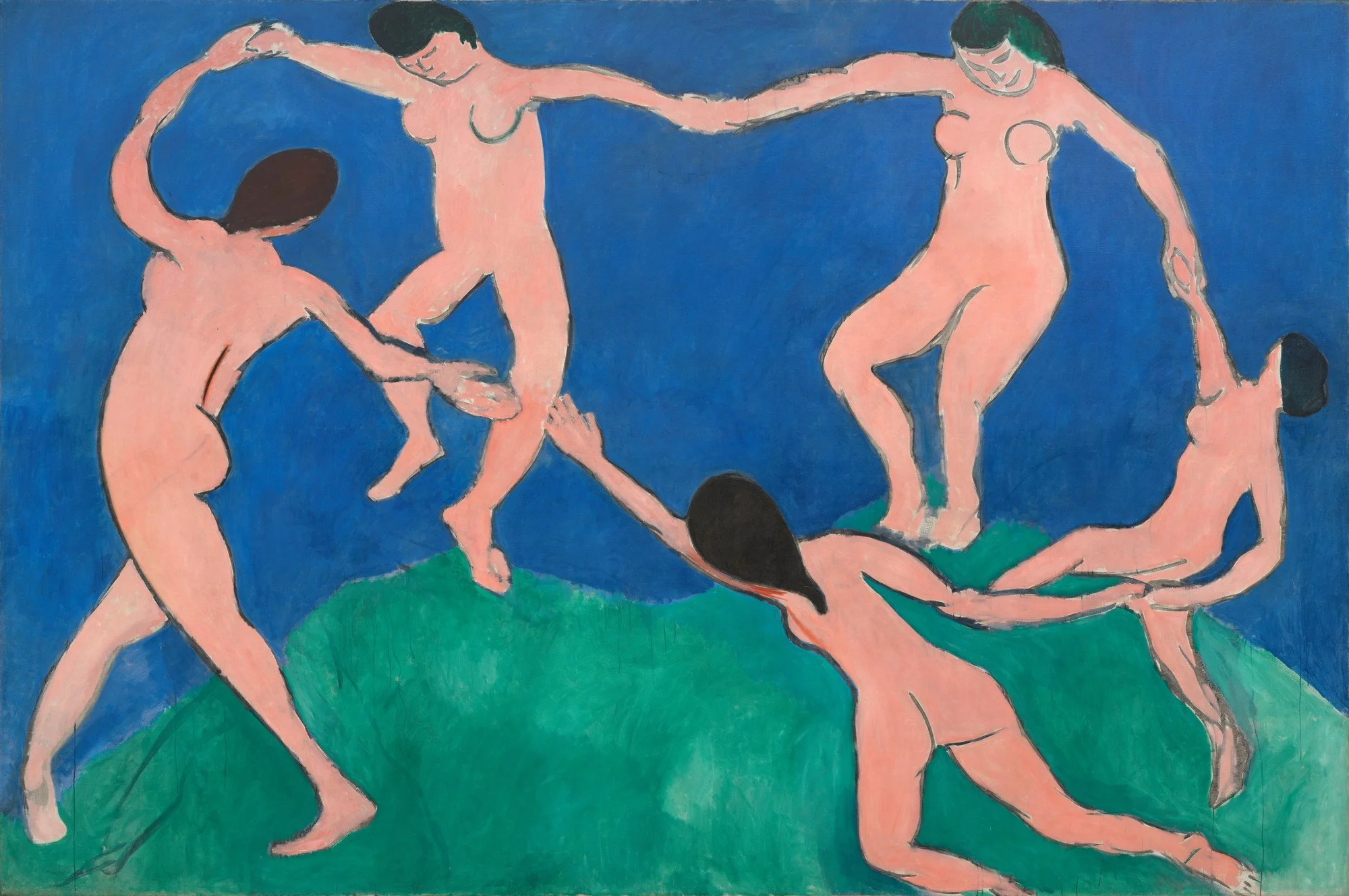
Dance (I), Henri Matisse, 1909. Museum of Modern Art, New York.
Modern life has made physical exertion remarkably optional. We sit to work, drive short distances, take lifts and move across smooth, predictable surfaces. We might complete a workout and still spend most of the remaining day almost entirely sedentary.
But the body does not only need exercise. It needs movement distributed throughout the day.
Walking, carrying, reaching, balancing, getting down to the floor and standing back up preserve different physical capacities. These ordinary movements support strength, mobility, coordination and confidence—the qualities that allow us to remain capable as we age.
Movement is bigger than exercise
A structured workout is valuable, but it cannot entirely compensate for spending the rest of the day sitting.
Research shows that interrupting prolonged sitting with short periods of movement can improve post-meal glucose and insulin responses. Walking breaks appear especially useful, while brief resistance-based movements can also help. The goal is not to perform a perfect miniature workout every hour. It is simply to give your muscles regular reasons to contract.
Try walking while taking a call, carrying your shopping, taking the stairs, standing up between tasks or completing a few comfortable squats after sitting for a long period.
Movement snacks: small bouts still count
One of the most practical developments in movement research is the concept of the movement snack: a brief burst of activity woven into the day rather than reserved for a formal workout.
This could be two minutes of stair climbing, ten controlled squats, a brisk walk around the block, carrying shopping home, dancing to one song or completing a short sequence of mobility exercises between meetings.
Movement snacks can interrupt prolonged sitting and repeatedly activate the large muscles involved in glucose uptake and circulation. Research suggests that frequent activity breaks can improve post-meal glucose and insulin responses compared with uninterrupted sitting, with short walking breaks producing particularly consistent results.
More vigorous “exercise snacks”—structured bouts lasting up to five minutes, completed at least twice a day—may also improve cardiorespiratory fitness in physically inactive adults. However, the research is still developing, and current evidence does not show that they independently improve every marker of cardiometabolic health. 2026 systematic review and meta-analysis
The value of movement snacks is not that two minutes magically replaces a complete exercise programme. It is that movement no longer has to wait until you have an uninterrupted hour available.
Try attaching them to moments already present in your day:
Walk for five minutes after a meal.
Take the stairs with purpose.
Perform 8–10 comfortable squats while the kettle boils.
Carry your groceries rather than immediately taking a taxi.
Stand, stretch or walk between calls.
Put on one song and move until it finishes.
Add a short burst of faster walking to your usual route.
Walk for cardiovascular and metabolic health
Walking is one of the most accessible forms of preventative medicine. Higher daily step counts are associated with lower risks of cardiovascular disease, several chronic conditions and premature mortality. Importantly, meaningful benefits occur below the frequently quoted target of 10,000 steps.
There is no universally perfect number. Begin with your current average and gradually increase it. Consistency is more valuable than chasing a target that does not fit your health, lifestyle or physical capacity.
The World Health Organization recommends 150–300 minutes of moderate-intensity activity each week, or 75–150 minutes of vigorous activity, alongside regular muscle-strengthening exercise. It also reminds us that some activity is better than none. WHO physical-activity guidelines
Squat to preserve function
The squat is not a miracle exercise, but it represents something important: the capacity to lower and lift your own body.
Squatting uses the hips, knees, ankles, trunk and large muscles of the lower body. Practising an appropriate squat can help maintain the strength and mobility needed to rise from a chair, lift objects, use the floor and move independently later in life.
Depth is individual. Anatomy, injury history and current mobility all matter. A supported squat to a chair or countertop is still worthwhile; there is no prize for forcing your body into a position it cannot comfortably control.
Strength is a health resource for women
From our thirties onward, preserving muscle and bone becomes increasingly important. This matters particularly across perimenopause and after menopause, when changes in ovarian hormones can contribute to losses in bone density, muscle mass and strength.
Progressive resistance training can improve strength and body composition and help counter age- and menopause-associated muscle loss. Muscle also plays a central role in glucose disposal and metabolic health. Review of resistance training in middle-aged women
Train the major muscle groups at least twice a week, gradually increasing resistance as your body adapts. Depending on your starting point, this might involve weights, machines, resistance bands or body-weight exercises.
The aim is not exhaustion. It is progressive challenge followed by adequate recovery.
Movement supports the brain as well as the body
Physical activity is associated with better mood, cognition and long-term brain health. Exercise can affect circulating brain-derived neurotrophic factor, or BDNF, a protein involved in neuronal function and plasticity.
Some research suggests exercise may help preserve hippocampal volume, although findings vary according to the population and type of training studied. It is therefore more accurate to say that movement supports brain health and may protect against aspects of age-related decline than to promise that it reverses ageing or directly grows new brain cells in humans. Meta-analysis of exercise and hippocampal volume
Take movement outdoors when you can
Exercise brings benefits wherever it happens, but natural environments may offer something additional. Nature-based walking and outdoor activity have been associated with improvements in mood, stress, anxiety, rumination and feelings of connection.
Uneven—but safe—terrain also asks more of balance, coordination and foot and ankle responsiveness than a treadmill or pavement. That doesn’t make urban walking ineffective; it simply gives us another reason to seek parks, woodland, beaches and trails when they are accessible.
Eat enough to protect muscle
Movement provides the stimulus, but muscle also needs sufficient energy and protein.
Protein requirements vary according to age, body size, health, activity and goals. For many active adults, approximately 1.2–1.6 g per kilogram of body weight per day may support the maintenance or development of lean mass. Older adults are often advised to consume at least 1.0–1.2 g/kg, with higher requirements in some active or clinical situations. These are guides, not universal prescriptions, and kidney disease or other medical conditions require individual advice. Protein and lean-body-mass meta-analysis
Spreading protein-containing foods across meals may be more practical than attempting to consume most of it at dinner.
A realistic weekly rhythm
Rather than searching for one perfect exercise, build a varied movement diet:
Walk frequently and interrupt long periods of sitting.
Strength train at least twice a week.
Include some activity that raises your breathing rate.
Practise balance, mobility and getting down to the floor.
Move outside and across varied terrain when it is safe.
Eat enough protein and total energy to support muscle and recovery.
Increase gradually—especially after illness, injury or a long period of inactivity.
Longevity is not created by one heroic workout. It is shaped by the movements repeated across a lifetime.
Walk more. Carry more. Squat in a way that suits your body. Build strength. Go outside.
The goal is not simply to live longer, but to retain the physical capacity to participate fully in your life.
Want to feel stronger, more energetic and better supported as you age?
In a one-to-one Naturopathic Health Consultation, we’ll assess your movement, nutrition, hormones, sleep and metabolic health—and create a realistic plan tailored to your body and lifestyle.
